Tuesday, May 30, 2023

ABTL event June 29 / 3d DCA pro tems

On June 29 from 6-8 p.m. ABTL-LA will hold its Annual Summer Judicial Reception, including judges from the Ninth Circuit and justices from the 2d District, at the Omni in DTLA. Details here; register here.

The 3d District notes the following judges are sitting pro tem:

  • Judge Samuel T. McAdam of the Yolo County Superior Court will be sitting in pro tempore beginning January 1, 2023.
  • Judge Garen J. Horst of the Placer County Superior Court will be sitting in pro tempore beginning May 1, 2023.
The 5th District has a new Fee list here.

Law.com has 2 Justices Diverge on Explaining Reasons for Recusals -- Justice Samuel Alito Jr. declines to follow the lead of Justice Elena Kagan, who last week explained why she did not participate in a case.

Friday, May 26, 2023

Just say 'yes' to amicus consent

Law360 has Feds Yank Amicus Opposition After Apparent Protocol Break

  • A federal prosecutor in Baltimore appears to have swerved out of his lane — and away from U.S. Department of Justice protocol — in staunchly opposing a routine motion for consent to file an amicus brief, only to be corrected a short time later by his office's appellate chief.
  • Appellate Chief Brandon Moore reversed course on Wednesday, when he filed a corrected response that consented to the NACDL's motion to file an amicus brief. Notably, Moore alone signed the filing, which did not explain why the government withdrew the motion.

Thursday, May 25, 2023

Citing unpublished cases

Bed's latest column, Finding Authoritative Authorities, has a lot to say about what to cite.

It’s fine to cite the great philosophers—like Justice Gilbert and I do—but you have to be a lot more careful with your case citations. Older case citations are always greeted with suspicion

Another thing you want to be careful with is unpublished federal decisions. This is a pit you may not have realized was even available for you to fall into. It’s a fluke.

unpublished federal authority is citable. Whether it will do you a lot of good is another matter.

So yeah, you can cite an unpublished federal decision, and if it’s more eloquent than you are, it might do you some good. Otherwise, consider Heraclitus or Patty Loveless.

Party poopers?

For Public Comment: Attending Law Firm Celebrations

The California Supreme Court Committee on Judicial Ethics Opinions (CJEO) invites public comment on a draft formal opinion addressing whether a judicial officer may attend a celebration hosted by a law firm.

In CJEO Draft Formal Opinion 2023-024, the committee generally advises judicial officers not to attend law firm celebrations because doing so could violate several canons in the Code of Judicial Ethics, including: the prohibitions against suggesting judicial bias or special influence over a judicial officer;
the prohibition against lending prestige to advance someone’s pecuniary or personal interests; and
the prohibition against accepting gifts, absent certain exceptions.

The judicial officer’s presence at such celebrations, the committee explains, may suggest the judicial officer has a special relationship with or endorses the law firm, which may undermine public confidence in the judicial officer’s fairness in cases where the law firm appears.

However, the committee said there may be exceptions. For example, it is generally permissible to attend an adult child’s or spouse’s law firm celebration because the judicial officer would already be disqualified from hearing matters involving the law firm and exceptions to the gift prohibition apply. There is also no prohibition against attending bar association events sponsored by law firms.

The committee’s Invitation to Comment is posted on CJEO’s recently updated website. Comments are due by July 10, and may be submitted by CJEO’s online comment form, by email to Judicial.Ethics@jud.ca.gov

Fed App Proc - No need to repeat

Today SCOTUS rules that "litigants can appeal purely legal issues they lost at the summary judgment stage without going through the technicality of raising them again after trial" per Law 360's 

BREAKING: Justices Open Door To Appeals Of 'Purely Legal' Issues

In a unanimous decision [Dupree v. Younger] written by Justice Amy Coney Barrett, the court overturned precedent from a minority of circuits that required litigants to raise legal issues in a motion for judgment as a matter of law after trial, through Federal Rule of Civil Procedure 50. When a "purely legal" issue is resolved at the summary judgment stage, it is preserved for appellate review without a Rule 50 motion, the court said.

See Law.com's ‘Empty Exercise’: Justices Back Appellate Review of Legal Issues Not Relitigated Post Trial -- Just going through the (Post-Trial) motions would be a waste of time, the Supreme Court says.

In other FedApp news, see Appeals Court Gives Clarity on Voluntary Dismissals, but Inconsistency Among Judges Remains -- Eleventh Circuit clarifies that plaintiffs can voluntarily dismiss entire lawsuits under Rule 41, but not individual claims.

Wednesday, May 24, 2023

Hot topic: Ethics

Bloomberg Law has Chief Justice Roberts Says He’s Committed to Highest Standards

Chief Justice John Roberts said he is “committed” to ensuring the Supreme Court adheres to the highest standards of conduct, even as some justices come under increased scrutiny by the public and Congress.

“I want to assure people I am committed to make certain that we as a court adhere to the highest standards of conduct,” Roberts said during remarks at an awards ceremony hosted by the American Law Institute. “We are continuing to look at things we can do practically to that effect.”

And Supreme Court Approval Slides Amid Thomas Ethics Controversies

Public confidence in the US Supreme Court slid amid a flurry of ethics controversies, including revelations that Justice Clarence Thomas got luxury vacations and other benefits from a Republican megadonor, according to a new Marquette Law School Poll.

The court’s approval rating fell to 41%, down six percentage points from January, the poll found. Only 25% of people expressed a great deal or a lot of confidence in the court, the lowest figure since polling began in 2019.

And Kagan Takes Small But Real Step Toward High Court Transparency -- Former deputy solicitor general of the US Philip Allen Lacovara says that Justice Elena Kagan made a small concession toward greater disclosure by providing the reason she recused from a case in the court’s weekly orders list.

And Law360 has a lesson in what not to write in an appellate brief, in Court Won't Review Atty's Penalty For Calling Judge 'Bitch'

One of those ethical violations was penning an off-color line in a 2013 brief to the Michigan Court of Appeals objecting to a state trial judge's ruling against him: "When the judiciary acts as the bitch for the complainant, we get rulings like this."

Lastly, in the "Apeal dismissed [sic]" category, see Painting Co. Can't Appeal After Sending Email 'Into The Abyss' about how sending a notice of appeal to "DOSHAApeals@Ini.wa.gov," leaving out a "p" in "Appeals" was ineffective, despite the filer's claim he is dyslexic and did not receive notice that his email was undeliverable. Lesson: Watch your "p"s...

Tuesday, May 23, 2023

Long SCOTUS arguments / en banc clinic @ UVA

Bloomberg Law has Long High Court Sessions Makes Advocates Happy, Stomachs Grumble

  • Eighty percent of Supreme Court arguments went over their allotted time this term, for an average of nearly 30 additional minutes.
  • The culprit is the pandemic-era shift away from the traditional free-for-all format that was largely time limited to a hybrid one that also includes a round robin.
  • Of the 59 arguments heard this term, only nine finished within five minutes of the allotted time. Just three went significantly under.
  • The remaining 47 cases went into overtime, though it varied from six minutes extra in the property rights case Wilkins v. US, to 93 additional minutes in Haaland v. Brackeen. That was on top of an already extended argument challenging a 1970s-era tribal adoption law, which was slated to last 100 minutes.
  • The spillover added 28 1/2 hours over the 63-plus hours of argument time anticipated.
  • Xiao Wang, a professor known for his innovations as an appellate clinic leader, is joining the University of Virginia School of Law faculty to direct its Supreme Court Litigation Clinic.
  • He plans to bring the network, and another new program ― the En Banc Institute ― to UVA. The institute offers lawyers who are scheduled to argue before full panels of appellate circuit court judges a place to practice their arguments in a full dress rehearsal before faculty, alumni and practitioners. In the last year at Northwestern, Wang has hosted 10 online and in-person moots.

Monday, May 22, 2023

Raining judges

The Recorder has Newsom Nominates 3 More Appellate Justices, 27 Trial Court Judges -- The California governor's superior court selections include many lawyers with a background in criminal law.

The DJ has Newsom nominates 3 to courts of appeal, names 27 trial judges -- Justice Brian Currey was nominated to serve as presiding justice of the 2nd District Court of Appeal, Division 4, where he has been an associate justice since 2018. Two judges were nominated to the 2nd and 4th District Courts of Appeal.

California Supreme Court to Hold Oral Argument Outreach Session in San Diego -- The California Supreme Court will hold a special oral argument session June 6 in San Diego. The special session will be attended by students from local high schools, including a school serving unhoused youth. Other attendees will include students aspiring to be the first in their families to earn a college degree and participants in a high school law academy that draws from San Diego’s diverse communities.

2d District Courtroom Closure: Extended The Ronald Reagan State Building's courtroom will remain closed for construction to complete technical upgrades until further notice. An update will be provided once the date of reopening has been confirmed.

Law.com has How Justice Jackson Succeeded Justice Breyer in More Ways Than One -- From their style at oral arguments to their interaction with law clerks, the similarities between Justice Ketanji Brown Jackson and her predecessor, Stephen Breyer, are striking.

And don't miss today's 9th Circuit certification to the Cal Supreme Court in Cassirer v. TBC:
The panel wrote that, in deciding to exercise its discretion to invoke the certification process, it considered that the case raised important, unresolved public policy ramifications of broad application regarding the ownership of stolen property, and that the issues were particularly thorny and substantial, given that stolen property cases may involve two innocent claimants to a specific piece of valued property which must be awarded to one claimant or the other. Further, in the spirit of comity and federalism, the panel recognized that the California legislature has expressed a particular policy interest in stolen art.
Dissenting from the certification order, Judge Bea wrote that, in his view, application of California’s three-step choice-of-law test to the facts of this case was straightforward, and Spanish law applied. Judge Bea wrote that improper certification harms state courts, strains the comity between federal and state courts, harms federal courts by encouraging forum shopping bids, and harms litigants through delays.

Sunday, May 21, 2023

New PJ & New Justices!


Governor Newsom Announces Judicial Appointments

Governor Gavin Newsom today announced his nomination of three Court of Appeal Justices: Justice Brian Currey as Presiding Justice of the Second District Court of Appeal, Division Four; Judge Helen Zukin as an Associate Justice of the Second District Court of Appeal, Division Four; and Judge Martha Gooding as an Associate Justice of the Fourth District Court of Appeal, Division Three.

The Governor also announced his appointment of 27 Superior Court Judges, which include one in Alameda County; one in Contra Costa County; one in Fresno County; one in Kern County; one in Kings County; seven in Los Angeles County; one in Orange County; two in Sacramento County; one in San Bernardino County; two in San Diego County; one in San Mateo County; one in Santa Clara County; one in Santa Cruz County; three in Sonoma County; one in Stanislaus County; one in Tulare County; and one in Tuolumne County.  
 
Second District Court of Appeal

Justice Brian Currey, of Los Angeles County, has been nominated to serve as Presiding Justice of the Second District Court of Appeal, Division Four, where he has served as an Associate Justice since 2018. He served as a Judge at the Los Angeles County Superior Court from 2014 to 2018. Justice Currey was Of Counsel at O’Melveny and Myers LLP from 2013 to 2014. He served as Deputy Mayor for Economic and Business Policy in the Los Angeles Mayor’s Office in 2013 and was Counsel to the Mayor from 2010 to 2013. Justice Currey was a Partner at O’Melveny and Myers LLP from 1989 to 2010, where he was an Associate from 1981 to 1989. He earned a Juris Doctor degree from the University of Virginia School of Law. Justice Currey fills the vacancy created by the retirement of Presiding Justice Nora Manella. This position requires confirmation by the Commission on Judicial Appointments, which consists of Chief Justice Patricia Guerrero, Attorney General Rob Bonta and Senior Presiding Justice Arthur Gilbert. Justice Currey is a Democrat.

Judge Helen Zukin, of Los Angeles County, has been nominated to serve as an Associate Justice of the Second District Court of Appeal, Division Four. She has served as a Judge of the Los Angeles County Superior Court since 2018. Judge Zukin was a Partner at Kiesel Law LLP from 2010 to 2018, where she was Of Counsel from 2006 to 2010. She was a Sole Practitioner from 1995 to 2006 and a Partner at Simke, Chodos, Silberfeld and Anteau Inc. from 1992 to 1995, where she was an Associate from 1990 to 1992. Judge Zukin was an Associate at Greene, O’Reilly, Agnew and Broillet from 1985 to 1990. She earned a Juris Doctor degree from Loyola Law School, Los Angeles. She is being nominated to fill the vacancy that will be created pending confirmation of Justice Brian Currey’s nomination as Presiding Justice of the Second District Court of Appeal, Division Four. This position requires confirmation by the Commission on Judicial Appointments, which consists of Chief Justice Patricia Guerrero, Attorney General Rob Bonta and Senior Presiding Justice Arthur Gilbert. Judge Zukin is a Democrat.

Fourth District Court of Appeal

Judge Martha Gooding, of Orange County, has been nominated to serve as an Associate Justice of the Fourth District Court of Appeal, Division Three. She has served as a Judge in the Orange County Superior Court since 2013. Judge Gooding was a Partner at Jones Day from 2011 to 2013. She was a Partner at Howrey LLP from 2000 to 2011. Judge Gooding was a Partner at Howard Rice Nemerovski Canady Falk and Rabkin from 1989 to 2000, where she was an Associate from 1983 to 1989. She earned a Juris Doctor degree from the University of California, Berkeley School of Law. Judge Gooding fills the vacancy created by the retirement of Justice Richard D. Fybel. This position requires confirmation by the Commission on Judicial Appointments, which consists of Chief Justice Patricia Guerrero, Attorney General Rob Bonta and Senior Presiding Justice Manuel Ramirez. Judge Gooding is a Democrat.
 
The compensation for each of these positions is $264,542.

Marsha Bipin Amin, of San Diego County, has been appointed to serve as a Judge in the San Diego County Superior Court. Amin has served as a Managing Attorney at the Fourth District Court of Appeal since 2018 and was a Senior Appellate Court Attorney there from 2011 to 2018. She was an Associate at Procopio from 2006 to 2010 and served as a Law Clerk at the U.S. District Court, Southern District of California from 2005 to 2006. Amin earned a Juris Doctor degree from the University of San Diego School of Law and a Master of Social Work degree from the University of Southern California. She fills the vacancy created by the retirement of Judge Laura Halgren. Amin is a Democrat.


Thursday, May 18, 2023

Today's federal appellate stories

The DJ has 9th Circuit nominee questioned on criminal law decisions -- Senate Republicans portrayed U.S. District Judge Ana I. de Alba as soft on crime.

Bloomberg Law has Medical Exam Demands and Aging Judges: Newman Saga Explained -- The clash between Newman and her colleagues on the US Court of Appeals for the Federal Circuit has sparked renewed attention on the consequences of lifetime appointments for federal judges.

Wednesday, May 17, 2023

Appellate roundup

The Judge Neman saga continues. Are you paranoid if they really are out to get you? Bloomberg law has‘Paranoid’ Incidents Necessitate Newman Exam, Fed. Cir. Says Law360 has Fed. Circ. Panel Says 'Bizarre' Newman Behavior Merits Exam -- "The committee of Federal Circuit judges investigating whether their 95-year-old colleague Judge Pauline Newman is mentally fit to remain on the bench ordered her on Tuesday to submit to medical examinations over what they described as her "bizarre" and "paranoid" behavior." And see Investigation Into Judge Newman's Competency Should Be Transferred, Ethics Experts Say -- Ethics experts agree that an investigation into 95-year-old Judge Pauline Newman’s ability to perform her duties at the U.S. Court of Appeals for the Federal Circuit should be transferred to a different court to avoid the appearance of prejudice.

Bloomberg Law also has Clarence Thomas Ethics Review Critic to Appear Before Senate

Law360 has Justice Breyer Says High Court's Power Lies With Public; Law.com has Breyer Looks Back on Sexism Faced by Female Harvard Classmates -- “They were having a tougher time than we thought,” retired Justice Stephen Breyer said of his female peers at Harvard Law School in the early 1960s.

Today's DJ has Justice Hoffstadt's Et tu, Bruton? -- In the last five years, the United States Supreme Court has overruled ten of its precedents. Will the Court “go to eleven” by overruling its 1968 decision in Bruton v. United States, 391 U.S. 123?

The U.S. Courts has posted Susan Oki Mollway, First Asian American Woman on Federal Bench: ‘Believe in Yourself’ -- In recognition of Asian Pacific American Heritage Month, a new video profile explores Mollway’s heritage. She cites the influence of her father, a soldier in the Army’s highly decorated Japanese American 442nd Regimental Combat Team; her mother, who stressed education; and Patsy Mink, the first Asian American woman in Congress.

Law.com has Fifth and Ninth Circuit Nominees Elicit Varied Responses at Senate Judiciary Hearing -- Fifth Circuit nominee Iris Carrillo Rodriguez was boosted by Texas' GOP senators, while Ninth Circuit nominee Ana de Alba faced tough questioning.

Monday, May 15, 2023

4/1 at high school

Outreach session

 Court of Appeal Holds Special Session for Imperial County High School Students -- More than 500 students from six Imperial County high schools attended oral argument hosted by the Fourth District Court of Appeal, Division One. The court heard two cases before the student audience at Southwest High School in El Centro.

Today's DJ has Myron Moskovtiz's Motions for summary judgment: Beware of "The UMF Trap!" which concludes:

Before including any “fact” in your UMF [statement of undisputed material fact], ask yourself two questions: (1) is there any possible way my opponent might produce evidence raising a triable issue of fact on this? And, (2) is it really material to one of my causes of action or defenses? If your answer is “yes” to #1 and “no” to #2, leave it out.

And CLA's May 2023 Litigation Update is available here.

Friday, May 12, 2023

3d Dist. courtroom closure

News from the 3d District: Notice regarding courtroom closure and May 2023 oral argument -- Please take notice that the courtroom is temporarily closed from April 25, 2023, through June 16, 2023, for construction to complete technical upgrades. The May 2023 oral argument will be held in historic room 500 of the Stanley Mosk Library and Courts Building, located on the fifth floor, 914 Capitol Mall, Sacramento, California 95814. It is anticipated that the courtroom will reopen for the June 2023 oral argument calendar.

News from the 6th District: The Court of Appeal, Sixth Appellate District, issued a new Miscellaneous Order today, May 10, 2023. Commencing with the June 2023 oral argument calendar, and continuing unless otherwise ordered by the court, the courtroom will be open to the public and media on a first come, first served basis. Regardless of vaccination status, all counsel and all members of the public who enter the courtroom are strongly encouraged to wear well-fitted face coverings. Click here to view the Misc. Order 23-001.

Embedded appellate counsel article

Today's DJ has Wilmer's Thomas Sprankling's The appeal of putting an appellate lawyer on a trial team:

  • an appellate attorney can add significant value to a case long before it is time to appeal and, potentially, head off the need for an appeal at all.
  • Perhaps the most natural place for an appellate lawyer to slot into a trial team is when it comes time to brief dispositive motions
  • an appellate lawyer can play an active role even if he or she joins the team in the middle of the case – for example, by leading the non-dispositive briefing and assisting with some of the tough strategy calls that arise in any litigation.
  • it is becoming increasingly common for appellate attorneys to embed themselves in a trial team just weeks or months before the trial begins. An appellate attorney can play an important role in three ways: preservation, perspective, and presentation of the law.
  • First, an appellate attorney can keep a close eye on the key legal issues during trial, making sure they are appropriately preserved for appellate review.
  • Second, because an appellate lawyer is used to appearing before judges rather than juries, an appellate specialist can provide a real-time perspective into what arguments and decisions are more likely to catch the eye of the court of appeal.
  • Third, an appellate attorney will feel at home in drafting the jury instructions, which – like dispositive motions – provide another opportunity to shape the purely legal questions that will be in front of an appellate court.
Abandonment of an appeal v. Dismissal of an appeal -- It makes a big difference, as seen in this unpub from 1/5 today.
"While the mistake may seem like a technicality, the courts rely on parties to file the correct forms in the correct courts, according to the rules."

Thursday, May 11, 2023

SCOCA to hear arguments in San Diego

California Supreme Court to Hold Oral Argument Outreach Session in San Diego

  • The California Supreme Court will hold a special oral argument session June 6 in San Diego. The special session will be attended by students from local high schools, including a school serving unhoused youth. Other attendees will include students aspiring to be the first in their families to earn a college degree and participants in a high school law academy that draws from San Diego’s diverse communities.
  • This is the court’s first special session since the COVID-19 pandemic began. The court has previously hosted more than a dozen student outreach programs that allow students to participate in and learn from the judicial process. The court last hosted an outreach program for San Diego students in 2016.
  • The court will host the session from the courtroom of the Fourth District Court of Appeal in San Diego.

Sanctions case!

Last Friday 1/4 published an appellate sanctions case here and blogged on by the California Appellate Report here. The opinion explains "nine out of the ten claims of error presented in the opening brief are frivolous under the Flaherty standard." And footnote 26 explains:

We publish this opinion because we believe it is important “to publicly illuminate a particularly egregious example of an abuse of the legal system and to bring to the attention of other courts, who may find themselves similarly burdened by litigation initiated by this same party.” (Kim v. Walker (1989) 208 Cal.App.3d 375, 386, fn. 10.) Borrowing some apt language from Kim, “our resolution of [this case] . . . appears to be only a small part of the extensive litigation which [Kinney] has commenced” (ibid.) and seems inclined to continue to pursue whenever the opportunity arises. The rarity of the set of circumstances presented and the type of misconduct involved meet the standards set forth in subdivisions (c)(2) [“Applies an existing rule of law to a set of facts significantly different from those stated in published opinions”] and (c)(6) [“Involves a legal issue of continuing public interest”] of rule 8.1105 of the California Rules of Court.

The opinion concludes: "The case is remanded to the probate court, where, upon satisfactory proof from the Special Administrator of the amount of reasonable attorney’s fees and costs incurred to respond to the frivolous portions of the appeal, the court shall award sanctions against Kinney payable to the Special Administrator. In addition, the sanctions order shall include a sanctions amount of $5,000 payable to the Clerk of this court."

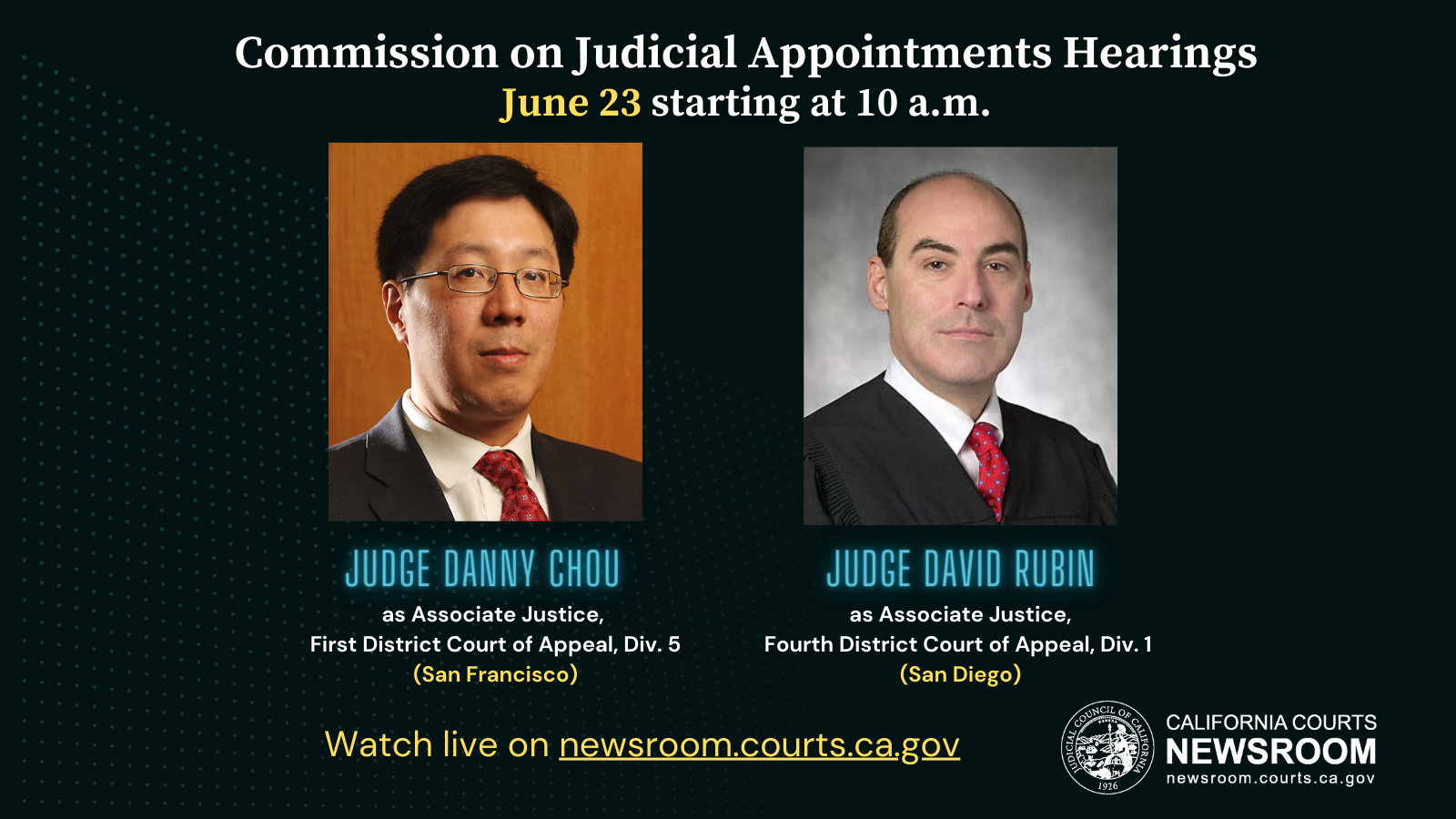
CJA Hearing set for June 23


    The Commission on Judicial Appointments will hold a public hearing on June 23 starting at 10 a.m. in the Supreme Court Courtroom—located on the fourth floor of 350 McAllister Street in San Francisco—to consider the appointments of:
  • Judge Danny Chou as associate justice of the First District Court of Appeal, Division Five (San Francisco)
  • Judge David Rubin as an associate justice of the Fourth District Court of Appeal, Division One (San Diego)
Seating in the courtroom will be limited—with some overflow seating also available in the Milton Marks Auditorium—and any mask requirements will be enforced as may be required by state and local health directives in effect at the time of the hearing. The hearing will be webcast live on the California Courts Newsroom. The state Constitution specifies that a gubernatorial appointment to the Court of Appeal is effective when confirmed by the Commission on Judicial Appointments. The commission members who will consider the appointment are California Chief Justice Patricia Guerrero (Chair); California Attorney General Rob Bonta; and Presiding Justice Jim Humes (for Judge Chou’s hearing), or Presiding Justice Manuel A. Ramirez (for Judge Rubin’s hearing).

SCOTUS arguments

To be filed under "problems we wish we had," Law.com has How Advocates Are Adapting to Changing Supreme Court Arguments -- Nobody ever said arguing before the justices was easy. But it seems to be getting harder as the formerly freewheeling, hourlong sessions have been replaced by more orderly questioning—and often exceed 60 minutes.

“I can remember the old, old days when prep was very different because you would only get maybe five to 10 questions in a 30-minute presentation,” said Carter Phillips, a veteran Supreme Court lawyer at Sidley Austin. “And then in the Rehnquist court, things got a little more intense because Scalia went on the bench,” Phillips said. “That seemed to change the dynamic for oral argument pretty dramatically, and I suppose for all time, or at least for the foreseeable future.” It took nearly four decades before the next transformation of high court hearings, when COVID-19 gripped the country and forced the Supreme Court to make a series of changes to its argument format. Those changes have created a “fundamental shift” in the substance and style of high court hearings, Phillips said. Perhaps most noticeably, hearings are lasting far longer—in some cases, more than three hours.

Law.com also has Solicitor General Prelogar: Expedited SCOTUS Briefings Mark 'Real Shift in How We Practice' -- The nation's second female solicitor general shared her thoughts Wednesday evening at the Third Circuit Judicial Conference on topics ranging from Oxford comma to a lengthier format for questioning advocates in Supreme Court hearings.

Wednesday, May 10, 2023

Shadow Docket program

LACBA's Appellate Courts Section presents The U.S. Supreme Court’s “ShadowDocket”

University of Texas School of Law Professor Stephen Vladeck will discuss his new book "The Shadow Docket: How the Supreme Court Uses Stealth Rulings to Amass Power and Undermine the Republic" and other SCOTUS matters.

Date: Tuesday June 6, 2023
Time: 12:00 PM - 1:00 PM
Location: LACBA Zoom Webinar
CLE: 1.0 Hour Appellate Specialized Credit 
Register here.

Also: University of Texas Law School Professor Stephen Vladeck, the author of "The Shadow Docket: How the Supreme Court Uses Stealth Rulings to Amass Power and Undermine the Republic" invites you purchase his new book at a discount: Anyone who pre-orders the book directly from the publisher will receive a 20% discount (use code “VLADECK20” at checkout).

And See the Wall St. Journal's review: ‘The Shadow Docket’ Review: Discretionary Matters


Tuesday, May 9, 2023

SCOTUS poetry

Today's DJ reports Manatt celebrates opinion-influenced poetry about its hosting the poet Harbani Ahuja on April 27 in its Century City office. She has written verses inspired by famous SCOUTS opinions. The firm is displaying visual art pieces illustrating the poems. The art series is titled Dicta and it explores the law and human rights in the U.S. through poetry created from the text of Supreme Court opinions, seeking “to educate and inspire the general public in the U.S. to better understand the timelessness of the struggle for human and civil rights, but also the progress made by legal activists.” Experience the exhibit and poems here.

CAAL new officers & members


California Academy of Appellate Lawyers Announces
New Officers and Two New Members

The California Academy of Appellate Lawyers is pleased to announce that at its May 6, 2023, meeting, it elected its officers for the 2023-2024 year and admitted as members Blithe S. Bock of the Los Angeles City Attorney’s Office and John E. Stobart of Capstone Law APC. The new officers are:

·         Laurie J. Hepler of Greines, Martin, Stein & Richland LLP, San Francisco, President;

·         Joseph P. Mascovich of Pacific Employment Law, Inc., San Francisco, Vice President;

·         Sean M. SeLegue of Arnold & Porter, San Francisco, Treasurer; and

·         Benjamin G. Shatz of Manatt, Phelps & Phillips, LLP, Los Angeles, as Secretary.

Ms. Bock, a Certified Appellate Specialist, is an Assistant City Attorney, representing the City of Los Angeles in a diverse range of appeals from Section 1983 litigation and employment to housing issues. She received her B.A. from the College of the University of Chicago and her J.D. from UCLA School of Law. She was the Supervisor of the L.A. City Attorney Civil Appeals Division from 2016 to 2022.

Mr. Stobart, a Certified Appellate Specialist and senior counsel with Capstone Law, represents employees and consumers in complex litigation, primarily wage-and-hour class actions and PAGA representative actions. He graduated cum laude from Thomas Jefferson School of Law where he was on the mock trial competition team and earned his undergraduate degree from the Ohio State University.

Founded in 1972, the Academy is the nation’s oldest lawyers’ organization dedicated to appellate practice. Our members are California lawyers with substantial appellate experience, who are elected to membership after rigorous scrutiny of their reputation, character, and appellate advocacy skills. Academy members are very frequently counsel of record in the most complex and highest-impact cases before the California Supreme Court, the California Court of Appeal, and federal appellate courts.

Monday, May 8, 2023

Bar Exam pass rate = 32.5%


The Recorder has Pass Rate on California's February Bar Exam Dips Below 33%. Although 1,224 applicants passed the February Exam, the pass rate was only 32.5%--the fourth time since 2013 that over two-thirds of test-takers failed the February exam. Graduates of ABA-approved schools in California had a pass rate of 49%.

Friday, May 5, 2023

Tone check on rehearing

Rehearing petitions often pose a problem for lawyers who can't moderate their tone. This week's installment on that comes from Florida. Law 360 reports Atty Who Called Judges 'Scumbags,' Slurs Faces Sanctions

After an attorney filed a motion asking a Florida state appellate panel if they and a trial judge were the "dumbest twats to adorn a bench" or "just dumb scumbags," the panel on Wednesday asked the attorney to explain why he shouldn't be sanctioned for violating court rules.


Similarly, see Law360's Use Of 'Hot Mess' In High Court Brief Draws Ire, But Isn't New
Kannon K. Shanmugam was excoriated on Twitter for calling U.S. Solicitor General Elizabeth Prelogar's work "a hot mess" in a brief filed with the U.S. Supreme Court, but the language and tone in his brief do have precedent, according to experts.
the specific phrase "hot mess" has shown up multiple times in federal courts and has even been used by judges themselves, according to Ilana Eisenstein, DLA Piper's chair of litigation and a former assistant to the U.S. solicitor general.
Law.com has Mandatory Retirement? Cognitive Assessments? Probe Into Judge’s Fitness Spurs Debate Over Life Tenure -- Pauline Newman's case also addresses the difficulty of telling older judges when they have lost more than a step.
some research has found that instituting mandatory retirement at state supreme courts led to an increase in productivity. Currently, 32 states have such requirements.
A not-yet-published paper by Princeton professor W. Bentley MacLeod and ETH Zurich professor Elliot Ash found that introducing mandatory retirement leads to an increase in a court’s published opinions and the number of forward citations to those opinions.
Fix the Court said in a statement that all circuits should establish a “wellness committee” to teach judges how to spot the signs of cognitive decline. According to a review by the judicial transparency group, most circuits had such committees as of 2019, but the Federal Circuit did not.

Wednesday, May 3, 2023

3d DCA pro tem update


The following are currently sitting on assignment in the 3d: 

  • Justice Andrea Lynn Hoch, retired, is sitting on assignment beginning January 1, 2023. 
  • Judge Samuel T. McAdam of the Yolo County Superior Court will be sitting in pro tempore beginning January 1, 2023.
  • Judge Garen J. Horst of the Placer County Superior Court will be sitting in pro tempore beginning May 1, 2023.

Here's a published opinion from the 5th that genteelly "parts ways" with some existing precedent and also provides some useful photos in an appendix.

And Justice Beds' latest column is An English Major's Lament
  • being an English major is not a historical fact. It’s a psychological condition
  • The symptomology is insidious. Onset is marked by a lot of reading, pleasant vocabulary, and a propensity to be “clever.” Since most of the K-16 educators are themselves liberal arts majors, the English major generally enjoys early success in academia.
  • But adulthood is not always kind to us. Turns out the rest of the world doesn’t much care about past participles. The rest of the world wouldn’t know a gerund from a groundhog … and they’re not in the least impressed that you do
  • A lot of words are sneaking into the language that I recognize as English but still have a hard time processing.7 Words like “nanoprocessor” and “blockchain” and “nonce.”

Appellate Bias Prevention Committee

Two appellate items of note in are today's DJ story Arab American lawyers mark heritage month with sold-out dinner. First, Supreme Court Justice Groban spoke at the event and "talked about the ways in which lawyers can secure bench appointments." He said "Being a judge is so much more [than traditional markers of achievement]," he said. "It's about being a good listener and having a high emotional IQ and not having an ego." He quipped, "We learned early on [during his tenure as judicial appointments secretary to Governor Brown] that nobody's ego went down when you put a robe on them."

Second, the article noted that honoree Rasha Gerges Shields, a Jones Day partner, was recently named to serve on a newly formed Supreme Court and Courts of Appeal Bias Prevention Committee. This Committee is chaired by Supreme Court Justice Jenkins, and includes justices from each district: Bendix, Boulware Eurie, Do, Fujisaki, Hill, Lie, McConnell, Peña, and 2d District Clerk/XO Eva McClintock.  The committee also includes has a variety of public and private appellate practitioners.

Today's DJ also has ABA study: Stanford Law produced most California federal clerkships -- Stanford Law School graduates landed the highest number of federal clerkships in California last year, but was third nationwide, after Harvard and Yale, according to a study from the American Bar Association.
  • Nearly 26% of Stanford Law School’s 180 graduates landed federal clerkships, with 48, in California last year, the highest percentage of the state’s U.S. court clerkships in the nation, according to a study from the American Bar Association released Monday. However, the school was ranked third for federal clerkships nationwide, behind Harvard, at 77, and Yale, with 51.
  • Data in the study suggests that 10 law schools were responsible for approximately 33% of the federal clerk hires in the nation, a situation that concerns some legal experts.
  • The ABA data states that federal judges hired 1,150 graduates, which is just 3% of all 2022 graduates, from U.S. law schools.
  • Additional California law schools that landed federal clerkships across the nation included: UC Berkeley School of Law, 20; UCLA School of Law, 20; Pepperdine Caruso School of Law, 10; UC Irvine School of Law, five; UC Davis School of Law, four; USC Gould School of Law, four; UC Law, San Francisco, three; Loyola Law School, three; Southwestern Law School, two; University of San Francisco School of Law, two; and California Western School of Law, one.
Law.com has Senators Debate Constitutionality of Imposing Ethics Law on Supreme Court -- Senate Judiciary Committee splits along party lines over separation-of-powers issue.
The U.S. Supreme Court has drawn intense scrutiny for being the only judicial body not subject to a binding ethics code. A Senate panel on Tuesday debated whether Congress could even pass such a code under the Constitution.


Bloomberg Law has Stevens Papers Provide Window Into Supreme Court Relationships

The Library of Congress on Tuesday released case files and other documents Stevens kept from 1984 to 2005, which showed the justices decades ago wrestled with some of the same issues they struggle with today.

Tuesday, May 2, 2023

Where are the SCOTUS opinions?

Law.com has As Clock Ticks, Supreme Court Opinions Still Coming at a Snail's Pace

  • With oral arguments out of the way, the Supreme Court can now start digging itself out from under the hefty pile of cases that still need to be decided. But summer recess is fast approaching.
  • The Supreme Court has decided just 14 argued cases so far this term. The court had already resolved 24 argued cases by this time in the two previous terms.
  • That slow output means the justices will have to decide 45 cases, more than three-fourths of their term load, before July if they want to leave in time for their regularly programmed summer break.

And Law.com has ACLU Staffs Up for New Initiative: 'State Supreme Courts Are More Important Now Than Ever' -- The American Civil Liberties Union is dedicating significant resources to state supreme court litigation, hiring two senior staff attorneys to work with ACLU state affiliates and local litigators on civil rights issues in state courts.

The DJ has Montana law school professor confirmed to 9th Circuit

For the latest disentitlement case, see here. And if you think you can submit trial exhibits after briefing has concluded, as here, think again (see fn.1).

The current issue of ASCDC's Verdict magazine has H&L's Marc Kressl's article Law and Linguistics: Tools of Construction, about the recent AJEI panel in Scottsdale on this topic.

And to truly geek out (re appeals and sci-fi) see the case of The Thing that got SLAPPed.

Want to know what's on the Cal Supreme Court's conference list tomorrow? Now you can see it here.

Monday, May 1, 2023

Johnstone confirmed to 9th Circuit


Law.com reports Senate Confirms Biden’s 32nd Appeals Court Judge -- Johnstone, a University of Montana law professor and former Montana Solicitor General, is Biden's sixth appointment to the U.S. Court of Appeals for the Ninth Circuit.

The U.S. Senate voted to confirm University of Montana law professor Anthony Johnstone to the U.S. Court of Appeals for the Ninth Circuit Monday evening. Johnstone will be the 32nd appeals court judge appointed by President Joe Biden. The nominee was confirmed by a vote of 49-45.

[Actually, isn't this Biden's seventh appointment to the Ninth?]

Ninth Circuit Press Release here.

Note: All 29 authorized judgeships for the Ninth Circuit are now filled!

Bloomberg Law has Biden Pick from Conservative Montana Confirmed to Ninth Circuit

Johnstone, who’s headed for the tribunal’s lone Montana seat, is a former state solicitor, or the state’s top lawyer in court, and most recently a professor at the University of Montana’s Blewett School of Law.
The University of Chicago Law graduate clerked for Bill Clinton’s Ninth Circuit appointee Sidney Thomas, and has been a member of the conservative Federalist Society and the progressive American Constitution Society. Those groups feature in his work as a law professor, for instance, as a panelist or moderator for student forums.

Appellate Job at LA City Atty Office


The Office of the City Attorney has an immediate opening for a Supervising Attorney of the Civil Appellate Division in the Civil Litigation Branch. Details here.

Attorneys interested in applying should submit their resume, writing samples, and 
cover letter in ONE (1) merged PDF FILE, via email to atty.recruit@lacity.org 
indicating, Supervising Attorney – CIVIL APPELLATE DIVISION (YOUR CALIFORNIA BAR NUMBER) #3262 in the subject line by FRIDAY, MAY 19, 2023.

ADC Appellate MCLE program


MAY 3, 2023 | 12:00pm - 1:00pm

Preserving Issues for Appeal and
Stays of Enforcement/Appeal Bonds 

 This webinar will cover strategies for preserving appellate issues in California state courts, including transcription of oral proceedings, motions in limine, objections, offers of proof, dispositive motions, trial briefs, jury instructions, verdict forms, and posttrial motions. The webinar will also cover the various methods available to obtain a stay of enforcement pending appeal and the mechanics of obtaining an appeal bond.

REGISTER HERE

ADC Member - $30/Non Member - $50. Are you a member of the ASCDC? Join the ADC for just an additional $100 per year by CLICKING HERE.

PRESENTED BY:


David M. Axelrad, Esq.

Horvitz & Levy, LLP