Tuesday, June 17, 2014

Justice Corrigan spars with KO

Last night was the Public Law Center's Volunteers for Justice 2014 Annual Dinner, a real who's-who, don't-miss-it legal event in Orange County. Many justices from 4/3 were there, including Justices Aronson, Fybel, and Ikola -- and PJ Kathleen O'Leary (aka KO). Rather than a keynote address, KO and Supreme Court Justice Corrigan engaged in an amusing conversation filled with friendly banter and repartee.

Justice Corrigan said that her favorite part of being on the Supreme Court is the writing; being able to make California law. Her least favorite part is the travel. The biggest change from being on the Supreme Court versus the Court of Appeal is that 7 is more than 3 -- i.e., it's harder to get a unanimous opinion. Also, there is much more conversation via written memo, rather than face-to-face discussions among the justices.

Justice Corrigan said that the best way to have a petition for review granted is to show a conflict among the appellate districts, to have a dissenting opinion in the Court of Appeal, or to point to the need to interpret new statutory language. She emphasized that although a quarter of the court's workload is death penalty appeals, every case gets white glove treatment.

Her oral argument tip was: Eat a good breakfast! Don't get up early and not eat breakfast; that is a recipe for passing out at the lectern, which she has seen happen twice. Beyond a good morning meal: Be smart; Be prepared; and don't lie.

The interview ended with a stirring rendition of the Notre Dame fight song.

Also mentioned was her devotion to St. Vincent's Day Home;
she is the President of the Board of Directors.

Hot appellate issue: how to pronounce cert?

How is ‘certiorari’ pronounced? Even Supreme Court justices disagree

Can you match the Justices to their respective pronunciations of "certiorari"?
• “ser-shee-or-RARE-eye,” rhyming with “fair guy.”
• “ser-shee-or-RAHR-ee,” rhyming with “Ferrari” or “car key.”
•  ___ pronounces the first two syllables “sertzee.”
• “ser-shee-or-ARR-eye,” rhyming with “far cry” or “czar guy.”
• “ser-shee-ARR-ee,” with a dropped syllable

Satisfaction of judgment = waiver of appeal = appellate sanctions

Be A Warning
When does a lawyer cross the line from "zealous advocacy" to "indefensible artifice"? That's the $25,000 question answered in today's appellate sanctions case from 4/1 here.
We next turn to Bay Vista's motion for sanctions. Bay Vista has filed a motion for sanctions, i.e., attorney fees in the amount of $25,000, which it has incurred in defending this appeal. As we discuss above, we determine Gildelatorre waived his right to appeal by executing the acknowledgement of satisfaction of judgment.

Swearing-ins

Monday's DJ reports Former State High Court Justice to be Sworn in as Ambassador, about an invitation-only event in Pasadena on Thursday where Former California Supreme Court Justice Carlos Moreno will be sworn in as ambassador to Belize. (His official swearing-in occurred May 31 at the State Department.)

Speaking of swearing-ins, click here for photos and an article about Friday's 9th Circuit shindig:
Ninth Circuit Convenes for Investiture of Judge Michelle T. Friedland

For a different kind of swearing article, see 
Contempt Charge Upheld For Atty's Foreign Profanity In Court

Friday, June 13, 2014

$1K appellate sanctions: MI Court of Appeals will not tolerate discourteous diss


 Stand Back, I'm A Professional

When appealing contempt sanctions, it is unwise to attack the trial court.
Reported here. See pages 58-59 here, or just read below:
IV. APPELLATE SANCTIONS 
Given the disrespectful and blatantly contemptuous statements made by attorney Charron in his appellate briefs regarding the trial court, we find the imposition of sanctions in accordance with MCR 7.216(C)(1)(b) (permitting actual or punitive damages or other disciplinary actions when a brief is “grossly lacking in the requirements of propriety”) to be appropriate. See also Grievance Administrator v Fieger, 476 Mich 231, 250-252; 719 NW2d 123 (2006). Specifically, this determination is premised on the numerous ad homenem and pejorative comments made and endorsed by Charron as the signatory on his appellate briefs, which include but are not limited to such outrageous and unprofessional statements as, “When the judiciary acts as the bitch for complainant, we get rulings like this.” (Emphasis added.) Such derogatory and undeserved comments serve no legitimate purpose, as they fail to advance Charron’s legal theories and violate MCR 7.212(C)(6), which requires an appellant’s brief to contain “[a]ll material facts, both favorable and unfavorable, [to be] fairly stated without argument or bias.” (Emphasis added.) 
 Therefore, and in accordance with the authority granted by MCL 600.2445(1), we sanction attorney Charron one thousand dollars ($1,000) for his failure to abide by the rules established for this Court and the civility expected by practitioners of the law. See MRPC 3.5(d) (barring “undignified or discourteous conduct toward the tribunal”). Attorney Charron’s privilege to file any further pleadings in this Court is suspended until such time as the imposed sanction is satisfied.

Are you a WSAS? (Well-Skilled Appellate Specialist)

Legal writing instructors and editors have been telling lawyers to stop using silly acronyms for ages. Some courts, like the D.C. Circuit, even implore counsel not to do that. Now, thanks to a D-Day concurring opinion by D.C. Circuit Sr. Judge Silberman, we all have some additional new federal appellate authority to cite (emphasis added; hat tip to Jeffrey Lewis):
Petitioner’s brief, unfortunately, was laden with obscure acronyms notwithstanding the admonitions in our handbook (and on our website) to avoid uncommon acronyms. Since the brief was signed by a faculty member at Columbia Law School, that was rather dismaying both because of ignorance of our standards and because the practice constitutes lousy brief writing.
The use of obscure acronyms, sometimes those made up for a particular case, is an aggravating development of the last twenty years. Even with a glossary, a judge finds himself or herself constantly looking back to recall what an acronym means. Perhaps not surprisingly, we never see that in a brief filed by well-skilled appellate specialists. It has been almost a marker, dividing the better lawyers from the rest.
We have recently been rejecting briefs that do not adhere to our instructions, and counsel should be warned that if a brief is rejected and has to be rewritten, they will not be able to alter the word limits.
The Fire Swamp
Here's a classic: ROUS.

Want to be California's next Reporter of Decisions? Apply now!

Supreme Court of California Seeks New Reporter of Decisions
Seal of the California Supreme Court
SAN FRANCISCO—The Supreme Court of California today announced a national recruitment for its 25th Reporter of Decisions to replace Mr. Edward W. Jessen, who retired earlier this year. The Reporter is responsible for supervising the preparation and publication of more than 12,000 appellate court opinions in the Official California Reports and the Official California Appellate Reports each year.
Appointed by the Supreme Court, the Reporter ensures the editorial integrity of all opinions of the Supreme Court and the Courts of Appeal from filing through publication, and reviews the accuracy of the editorial information included in the advance sheets and final bound volumes.
The Supreme Court is accepting applications from both internal and external candidates. Minimum qualifications include possession of a juris doctor degree and active membership in the State Bar of California, or in the bar of another jurisdiction. A full list of qualifications, responsibilities, skills required, and application information is available in the job posting (#3874) on the California Courts Careers Web page.
The Supreme Court is an Equal Opportunity Employer. The salary range for the position is $10,900-$12,883 per month, and the position includes a comprehensive benefits package.
Mr. Edward W. Jessen was the longest serving Reporter of Decisions in the Supreme Court’s history, with 25 years of public service in the post. Other notable Reporters have included Mr. Bernard E. Witkin.

How important is the job? Well...
Commas Save Lives!

International Arbitration?


Never Judge A Book By Its Movie

International Arbitration: Not a concept that resonates with appellate practitioners. Arbitration is anathema because it generally precludes appeals. And because, like politics, all appellate practice is "local," the term "international" does not spark the excitement of the appellate bar. So why are we talking about this?
Well, today's DJ has a book review of Gary Born's International Commercial Arbitration (2d ed.) -- a trio of volumes, weighing in at 4,408 pages. Who would tackle such a book review? You'd need someone with a keen interest and unparalleled background in the field. Paging Justice Mosk! On cue, Justice Mosk arrives, and with a favorable review to boot.
All we can say: Appellate lawyers will probably be waiting for the movie...

In other news:
Friday the 12th
Rejoice! Today IS Friday the 13th.
And tomorrow is World Gin Day -- a "holiday" that may be observed by a few lawyers...

And, congrats to the 21 Appellate Rising Stars listed in SoCal Super Lawyers here.

Monday, June 9, 2014

2013-14 Cal Supreme Court Round-Up program

On Thursday, 6/12/14, noon, at McCormick & Schmick's downtown, the LA Chapter of the Federal Society (also with co-sponsor The Libertarian Law Council) presents its Supreme Court Round-Up, where "four seasoned appellate practitioners [Rex Heinke, Lisa Jaskol, Julian Poon and Jeremy Rosen] will review the California Supreme Court's most significant decisions in 2013-14." For $25, this is a steal -- and at McCormick's you might even have steelhead for lunch.


For the "seasoned" appellate lawyer:
salt & pepper shaker gavels!


Also: Don't miss today's DJ profile of 1/1's Justice Dondero.

Friday, June 6, 2014

Speak up! Tentative Opinion Survey

Hey Appellate Lawyers! Do you have thoughts to share about 4/2's tentative opinion program? (How could you not?!)
Now's your chance to share those thoughts with the Court of Appeal. Below is a survey the court is circulating. You can return completed surveys to the court by  mail (3389 12th Street, Riverside, CA 92501) or by email to paula.garcia@jud.ca.gov -- BUT don't use that email address for any communications with the court other than returning completed surveys!

TENTATIVE OPINION SURVEYFOR COUNSEL
          The Court is interested in learning whether and how its tentative opinion program affects appellate practitioners and would appreciate your feedback in the form of responses to a short survey.  Please take a few minutes to respond to the following questions as they pertain to your current matter or past matters in the Fourth District Court of Appeal, Division Two.  Your responses will remain anonymous.  Please return your completed survey to the court.

1.  Without listing a case name, please check below the type of case:
______Civil       ______Criminal       ______Juvenile

2.  Did/does the tentative opinion aid, assist, or promote your decision to waive or confirm oral argument?
          ___ Yes           ___ No

          If yes, how?

3.  Did/does the tentative opinion aid, assist, or promote your preparation for oral argument? 
          ___ Yes          ___ No

          If yes, how? 

4.  Did the tentative opinion in your case include an indication that the panel was considering publication of the opinion?
           ___ Yes          ___ No

     If yes, did that information aid, assist, or promote your decision to request or confirm oral argument?
           ___ Yes          ___ No

          If yes, how?

5.  Did you receive a notice that the tentative opinion was not unanimous?
          ___ Yes          ___ No

          If yes, how?

6.  Please share any additional comments or observations relating to your experience with the tentative opinion program.

Did ya hear the one about...

Justice Bedsworth's latest column, Fall From 'Heaven' Is Stranger Than Fiction, appears in today's Recorder here.


From the ABA Journal: Judges should admit goofs instead of quietly revising opinions, says 9th Circuit judge:

Writing for the Arizona Law Review (PDF), Judge Andrew Hurwitz of the San Francisco-based 9th U.S. Circuit Court of Appeals says judges should be more transparent about their errors. The Wall Street Journal Law Blog notes the article.

Thursday, June 5, 2014

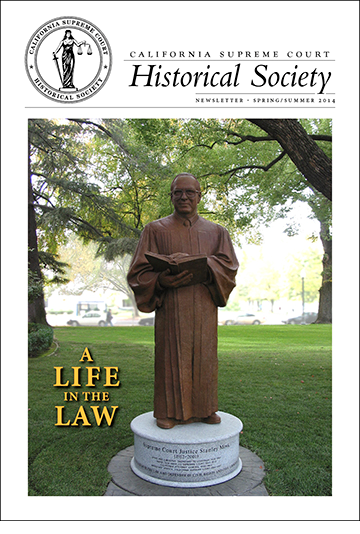
Cal Supreme Court Historical Society Newsletter available now


NOW AVAILABLE: Spring/Summer 2014 Newsletter

Highlights from a new biography of
Justice Stanley Mosk:
The Longest-Serving Justice

including the story of "His Only Death Sentence" as a trial judge
A House for Equal Justice
The Los Angeles County Courthouse and architect Paul Williams
Succession in the California Supreme Court
From 1880, when the seven-member court first convened, to present
The First Jury Trial in California
In 1846 in Monterey, a very public display of American justice
Trademarks and Washing Powder in Old San Francisco
California law was the first to allow registration of trademarks

Historic Photographs from the Corridors of the Supreme Court
WWII Dormitory barracks in the San Francisco Civic Center

VIEW THE SPRING/SUMMER ISSUE

Wednesday, June 4, 2014

Um, is there a(n appellate) lawyer in the house?

To see a somewhat unusual way for an appeal to get dismissed, read this messy situation (here), which, 15 pages later, ends like this:
Thus, appellants Camellia Valley Supply, Inc. and CV Supply, Inc. are without legal counsel on this appeal. “ . . . [U]nder a long-standing common law rule of procedure, a corporation, unlike a natural person, cannot represent itself before courts of record in propria persona, nor can it represent itself through a corporate officer, director or other employee who is not an attorney. It must be represented by licensed counsel in proceedings before courts of record. [Citation omitted.]” (CLD Construction, Inc. v. City of San Ramon (120 Cal.App.4th 1141, 1145; Paradise v. Nowlin (1948) 86 Cal.App.2d 897, 898.) Being without counsel, Camellia Valley Supply, Inc.’s and CV Supply, Inc.’s appeal must be dismissed.

Tuesday, June 3, 2014

Awards, awards, rubber chicken...

You'll recall that Ninth Circuit Judge Alarcon recently received LACBA's Outstanding Jurist Award. But I bet you're dying to know just what the actual "award" looks like, right? Well, here it is:
If you can't tell, it's a bust of Solomon.
"Just what I've always wanted!"
Also, at LACBA's June 26 Installation & Awards dinner, appellate lawyer Ed Horowitz will be receiving the Matthew S. Rae Outstanding Section Leader Award for his amazing leadership of -- not the Appellate "Section", which he chaired back in its committee days in the early 1980s, but -- the Senior Lawyer's Section, which as we've reported before deserves praise for the cutest bar logo ever!

Speaking of LACBA, the Appellate Section's next meeting will be June 18 (Wednesday, not the usual Tuesday) titled "What are YOU doing here? The Role of Appellate Counsel in the Trial Courts."

Today was the 60th annual Beverly Hills Bar Ass'n Supreme Court lunch, at which Justice Kennard gave a stirring rendition of her life story and the glories of American freedom, and the Chief gave a state of the judiciary update. The event was held at the Montage, and the lunch was far better than the usual rubber chicken.

Monday, June 2, 2014

The 90-day rule debate

Today's DJ has another great Emily Green article about California Constitution article IX, section 19, aka the 90-day rule: State Supreme Court's drafting of decisions before oral argument draws fire -- Professor says 90-day decision deadline leads to delays, not efficiencies. UCLAw Professor Daniel Bussel says that the 90-day rule makes oral argument "a theater of the absurd" and "Kabuki theatre." Justice Liu responds that the professor doesn't get it. The current issue of UCLA Law Review contains Bussel's critique, Justice Liu's response, and the professor's reply.
(For a 90-day rule primer, click here.)


"May it please the (Kabuki) court..."

"According to Bussel's analysis, median disposition times increased from 386 days in 1984 to a peak of 618 days in 2007 before falling to 441 days in 2011."

Also in today's DJ: PJ Gilbert's latest column, A Secret Purchase in Paris, about buying Tropic of Cancer in in France in 1960, which he describes as "More lively than promissory estoppel."
In selecting blog pics, always keep it clean.

Also today: Supreme Court Marks Passing of Michael Millman -- Executive Director of California Appellate Project; Pillar of the Capital Defense Bar.

Thursday, May 29, 2014

2d DCA pro tem assignments

The following are currently sitting on assignment:
  • Judge Rita Miller of the Los Angeles Superior Court, will be sitting Pro-Tem in Division One until July 31, 2014
  • Judge John Shepard Wiley, Jr. of the Los Angeles Superior Court, will be sitting Pro-Tem in Division One until July 31, 2014
  • Judge Edward A. Ferns of the Los Angeles Superior Court, will be sitting Pro-Tem in Division Two until July 31, 2014
  • Judge Lee Edmon of the Los Angeles Superior Court, will be sitting Pro-Tem in Division Four until July 31, 2014
  • Retired Judge Michael Mink will be sitting Pro-Tem in Division Five until July 31, 2014
  • Judge Earle Jeffrey Burke of the San Luis Obispo Superior Court, will be sitting Pro-Tem in Division Six until July 31, 2014
  • Judge John Segal of the Los Angeles Superior Court, will be sitting Pro-Tem in Division Seven until July 31, 2014
  • Judge Russell S. Kussman of the Los Angeles Superior Court, will be sitting Pro-Tem in Division Eight until July 31, 2014
Also, here are some squirm-worthy lines from decisions today:
Case 1We vacate the order, concluding the court was without jurisdiction to consider the motion, a conclusion based on The Law Offices of Andrew L. Ellis v. Yang (2009) 178 Cal.App.4th 869 (Yang), a case that is on point—a case, most remarkably, not cited in either side’s brief. 
Case 2At the outset, we note that plaintiffs' factual summary in their opening brief is substantially one-sided and argumentative, in violation of California Rules of Court rule 8.204(a)(2)(C) that a brief must "[p]rovide a summary of the significant facts limited to matters in the record." [Footnote: "It is not clear why plaintiffs in their statement of facts engaged in substantial argument and presented the facts in such a one-sided manner, given that the first several pages of their 50-page opening brief were dedicated to their introduction/summary of argument that was all argument."]
[6/5/14 addition] Here's a cute line in a decision from 4/2's Justice Richli:
"We find no error. Indeed, we congratulate the trial judge (the Honorable John G. Evans) on spotting this dispositive issue, even though it was well camouflaged amidst the parties’ numerous arguments and voluminous evidence."