| "Well, isn't that special" |
Tuesday, April 16, 2013
Lurking problems in the complex world of post-trial practice
Today's DJ has an article from Kasey Curtis and Paul Fogel about post-trial practice lessons to be learned from 2/1's opinion in Webb v. Special Electronic Co., Inc. (March 14, 2013) 214 Cal.App.4th 595.


Monday, April 15, 2013
OSCAR gets a makeover...
The Third Branch News reports:
OSCAR Update Adds Transparency to Clerkship Process
A major redesign of a popular online resource for law clerkships will make the federal law clerk application and review process more orderly, transparent, and fair for all. Version 7 of the Online System for Clerkship Application and Review (OSCAR) was released this month by the Administrative Office of the U.S. Courts.
Read the full story and watch the video.
|  |
Friday, April 12, 2013
Justices Beds on Hypothecation by Bottomry
Another masterpiece of legal scholarship lies here. If you don't know about hypothecation by bottomry this is a must read; and if you do, then it's an even must'er read. MCLE credit awaiting approval from the House of Lords. (Actually, maybe you should deduct MCLE credit from your tally after reading!)
Respondentia (1) a loan where a ship's cargo is the security, on similar terms to bottomry; (2) discoloration of the skin from filing too many briefs with yellow covers.
| Lord Fozziwick and Lord Chenneyworth? |
Thursday, April 11, 2013
Tricky reconsideration appealability analysis
Motions for reconsideration can make for some tricky questions about when the time to appeal starts. Today's publication of last month's decision by 1/2 may help untangle the mess. It holds that material or substantial modification of an order restarts the time to appeal -- whether or not the trial court grants or denies reconsideration.
| Probably not the CATS (Community Awareness Treatment Services) members involved in this case. |
Wednesday, April 10, 2013
For Your (Re)consideration (re attorney fault affidavits)
Does the reconsideration statute (CCP 1008) apply to a renewed section 473 motion (for mandatory relief based on an affidavit of attorney fault)? Back in 2009, the 6th District said "no" in Standard Microsystems.
Today, 2/4 says "yes."

Split (the position)...

You get the idea...
Other pics illustrating aspects of this case:

No Two Bites @ the Apple

Today, 2/4 says "yes."
Split (the position)...
Split (the city)
You get the idea...
Other pics illustrating aspects of this case:
No Two Bites @ the Apple
You Don't Mess With the Zohar
Will your brief be read?
Today's DJ features an article by Appellate Specialist David Wilson (of Manning & Kass, et al.) providing advice about how to write a compelling brief that will be read. He advises: "Think like a lawyer, write like a human being," "Keep your audience in mind," "Know the rules; and when to break them," and "Use exactly the right word."

Also, yesterday's DJ profiled LASC Judge Michael Raphael, who clerked for a 6th Circuit judge, and went on to spend five years dedicated to appellate work at the US Attorneys' Office in LA, eventually becoming chief of criminal appeals. The article's pullquote: "I've always had what you might call an intellectual interest in the law."
Also, yesterday's DJ profiled LASC Judge Michael Raphael, who clerked for a 6th Circuit judge, and went on to spend five years dedicated to appellate work at the US Attorneys' Office in LA, eventually becoming chief of criminal appeals. The article's pullquote: "I've always had what you might call an intellectual interest in the law."
Tuesday, April 9, 2013
The RT Wars continue...
This time it's an appeal from a preliminary injunction order. Is a reporter's transcript really necessary for such an appeal? According to the majority here, it sure is. (And you already knew this decision is from 2/5, right?)
Defendants argue the trial court abused its discretion in granting the preliminary injunction because it misapplied the law and relied upon inadmissible evidence. But defendants concede they did not provide this court with a reporter’s transcript of the hearing or a suitable substitute. Defendants assert the reporter’s transcript is unnecessary because the trial court’s opinion and the basis for its order are set forth in the written minute order. But a judgment is presumed to be correct and appellant has a duty to provide the reviewing court with an adequate record to demonstrate error. [cites] Without a proper record, we cannot determine whether the trial court abused its discretion in granting the preliminary injunction. In numerous situations, appellate courts have refused to reach the merits of an appellant’s claims because that appellant failed to provide a reporter’s transcript of a pertinent proceeding or a suitable substitute.
| Episode XIII: Revenge of the Missing RT |
And speaking of the missing record material tanking an appeal, here's one today (from 1/1): If you're appealing from a summary judgment, you better include the summary judgment motion (and the complaint) in the record! (Yes, even if you're acting pro per.)
Monday, April 8, 2013
Appellate Lessons from a Brown Eyed Girl
Last month the California Supreme Court issued an opinion (Bourhis v. Lord) on appellate jurisdiction that has several points of interest. (You may already have read about it, perhaps here?)
 Here's the story: Appellant Brown Eyed Girl, Inc. filed two notices of appeal while its corporate powers were suspended for failure to pay its taxes. Respondents filed motions in the Court of Appeal (1/2) to dismiss the appeals. Those motions prompted BEG to pay its taxes, allowing it to argue that its corporate revival validated its notices of appeal. The Court of Appeal was ok with that and denied the motions to dismiss.
Interesting issue #1 (PFR): Respondents successfully filed petitions for review from the orders denying the motions to dismiss the appeals. (See CRC 8.500(a)(1).) You don't often see successful PFRs from motions. The Supremes took up the issue of "whether a corporation that files notices of appeal while its corporate powers are suspended may proceed with the appeals after those powers have been revived, even if the revival occurs after the time to appeal has expired."
Interesting issue #2 (Stare Decisis): As cited in the Court of Appeal's order, two Supreme Court cases from the 1970's had held that revival of corporate powers validates an ealier notice of appeal. (But neither case indicated whether the revivals at issue there came before or after the expiration of the jurisdictional time to appeal.) Had the time come to overturn (or distinguish) those cases? Nope: stare decisis wins out this time:
Good arguments can be made for both sides of this issue. From a practitioner's point of view, anything that helps to keep appeals alive and addressed on their merits is welcome. And this may help the State's coffers by encouraging delinquent corporations to pay their taxes.
Interesting issue #4 (lawyer MIA for the oral argument!): At the Lectern covered this point here.
Finally, point #5 -- The Van Morrison pic was a no-brainer... But who knew that Brown Eyed Girls were a K-Pop group? Now you do.
Interesting issue #1 (PFR): Respondents successfully filed petitions for review from the orders denying the motions to dismiss the appeals. (See CRC 8.500(a)(1).) You don't often see successful PFRs from motions. The Supremes took up the issue of "whether a corporation that files notices of appeal while its corporate powers are suspended may proceed with the appeals after those powers have been revived, even if the revival occurs after the time to appeal has expired."
Interesting issue #2 (Stare Decisis): As cited in the Court of Appeal's order, two Supreme Court cases from the 1970's had held that revival of corporate powers validates an ealier notice of appeal. (But neither case indicated whether the revivals at issue there came before or after the expiration of the jurisdictional time to appeal.) Had the time come to overturn (or distinguish) those cases? Nope: stare decisis wins out this time:
The doctrine of stare decisis teaches that a court usually should follow prior judicial precedent even if the current court might have decided the issue differently if it had been the first to consider it. This doctrine is especially forceful when, as here, the issue is one of statutory construction, because the Legislature can always overturn a judicial interpretation of a statute. The doctrine of stare decisis is not absolute, and sometimes it is appropriate to overrule prior precedent, even precedent interpreting a statute. Nevertheless, a court should be reluctant to overrule precedent and should do so only for good reason.Interesting issue #3 (the merits): In a mere ten pages Justice Chin whips out a crisp affirmance and is joined by every other justice, except Justice Kennard. She takes the hard-line view that appellate jurisdiction is wholly dependent on the timely filing of a valid notice of appeal, and an invalid notice of appeal simply cannot be "saved." Justice Kennard goes on to argue that the cases from the 1970's "were wrong then, are wrong now, and should be overruled."
Good arguments can be made for both sides of this issue. From a practitioner's point of view, anything that helps to keep appeals alive and addressed on their merits is welcome. And this may help the State's coffers by encouraging delinquent corporations to pay their taxes.
Interesting issue #4 (lawyer MIA for the oral argument!): At the Lectern covered this point here.
Finally, point #5 -- The Van Morrison pic was a no-brainer... But who knew that Brown Eyed Girls were a K-Pop group? Now you do.
 |
| Singing their hit "8.104 is Jurisdictional" (to the tune of 8675309/Jenny) |
AG's office called out for subpar briefing
This blog often reports on poor appellate lawyering as reflected in court decisions. Today's installment shows that not even the AG's office is immune: see here (footnote 1):
The Attorney General essentially abdicated her role as counsel for a party to these proceedings on this sufficiency of evidence issue. Responding to the insufficiency argument, which extended 27 pages in the appellant's opening brief and included numerous arguments concerning specific evidence, the Attorney General provided a little more than one page summarizing the evidence, without addressing defendant's specific arguments about the evidence. The Attorney General did this after we struck her first brief and directed her to file a new brief. We stated: "The Attorney General is directed to serve and file a respondent's brief, responding in detail to the appellant's opening brief . . . ." Because we cannot reverse unless there is a miscarriage of justice (Cal. Const., art. VI, § 13), we cannot deem the Attorney General's minimal treatment of defendant's arguments a concession of their merit. Nonetheless, the Attorney General's failure to respond appropriately in this case is unacceptable.
Friday, April 5, 2013
Don't call us, we'll call you.
An opinion from the 9th Circuit last month listed no case number, case origin, or case type on the published opinions webpage. Already that's a good sign that something interesting is afoot. And if you're a procedure geek, you will love this one:
IN RE MOTOR FUEL TEMPERATURE SALES PRACTICES LITIGATION
IN RE MOTOR FUEL TEMPERATURE SALES PRACTICES LITIGATION
I very much appreciate Chief Judge Vratil’s willingness to help with our workload, and I hope that she’ll consider doing so in the many other cases where we have a well-documented necessity for judicial help from outside the circuit.
| This Yellow Brick Road does not lead to California. |
Thursday, April 4, 2013
A neat way to win an appeal: Disentitlement!
Here's a neat trick:
Defendants, an individual and a corporation, appealed from a California judgment in favor of plaintiffs, but did not post a bond to stay enforcement of the judgment. Plaintiffs, after registering the judgment in New York where defendants are located, attempted to enforce the registered sister-state judgment there by serving a subpoena seeking financial information from the corporate defendant. Defendants did not comply with the subpoena or with a New York trial court order compelling them to respond to it. As a result, the New York trial court held defendants in contempt. In dismissing defendants' appeal under the disentitlement doctrine, we hold that the doctrine applies to noncompliance with and contempt of New York trial court orders, which noncompliance and contempt directly affect and frustrate the enforcement of a California judgment.
The Met News has an article about the case:
Court of Appeal Clarifies Application of Disentitlement Doctrine
Panel Says Rule Applies to Evasion of Sister-State Court Orders
Crossing the line?
As a former NHL goal judge, 4/3's Justice Bedsworth has a keen eye for seeing when something moving fast crosses the line. In yesterday's decision of AAA Blueprint v. Vasquez, he brings that skill to bear on an appellant:
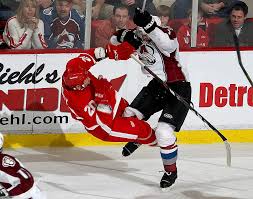
Check!


Reader Charles Hokanson points out that Respondent takes a blow as well, in footnote 5:
While we agree that appellants’ briefs are dismal specimens of appellate advocacy, we must be careful not to equate poor lawyering with frivolousness.
Check!
Body check!We agree that appellants’ briefs could be used in law school classes on appellate advocacy as examples of how not to do an appellate brief.
Violations of the rules of court and of accepted appellate practice occur on almost every page. For example, appellants repeatedly cite to documents (i.e., defense trial exhibits) that are not in the record before us. [cite] Appellants do not give a comprehensive summary of the evidence presented at trial, as they are obliged to do when they identify insufficient evidence as an issue. [cite] The sole case on which they rely to support their lack of standing argument ... has almost nothing to do with the issue.But not checkmate! Sanctions are narrowly avoided because "However ineptly, appellants raised issues not totally devoid of merit. We therefore deny the motion for sanctions."
Reader Charles Hokanson points out that Respondent takes a blow as well, in footnote 5:
We should also point out that, while appellants cited to documents not in the record, [Respondent] committed the worse sin of misrepresenting what the record said and did so often enough to create a pattern of misrepresentation. [cite]We could properly commend all of the briefs to our hypothetical appellate advocacy class as cautionary examples.
Chief Alex Kozinski to recieve the Gumpert Award
The Center for Civic Mediation's 20th Annual Awards Dinner will be April 18 at The L.A. Hotel Downtown (333 S. Figueroa) and will honor (posthumously) U.S. Ambassador J. Christopher Stevens with the Louis M. Brown Conflict Prevention Award and honor 9th Circuit Chief Judge Alex Kozinski with the Emil Gumpert Judicial Services Award.

| Emil Gumport |
J.R. versus Guru Baba
Yee Haw! It's an old fashion boundary dispute out in Ojai with some colorful characters and some interesting law... Nothing brings back those fond 1L years like an excursion into adverse possession...
"A Bad Outcome for Mr. Good"
Last month we posted about judicial rescuse missions and Mr. Good's "stubborn refusal" to follow the appellate rules (here). A more detailed discussion of Good v. Miller appears in yesterday's Daily Journal article "A Bad Outcome for Mr. Good," by Reed Smith's Appellate Practice Group Chair Paul Fogel (Hon. ret.) and associate Ilana Herscovitz. They characterize Good's result as "harsh yet refreshing." Makes it sound like a stiff drink...

More on Moore!
Today's DJ profiles 4/3's Justice Eileen Moore. Here are a few "take aways":


- caring demeanor; very compassionate person; a humanitarian
- enjoys the scholarly side of the law and writing
- combat nurse in the Vietnam War; mentors veterans
- profits from a macrame business, Knots & Pots, funded law school at Pepperdine
- tort plaintiffs lawyer in practice; cross-examined Pat Boone and Wally George
- a Republican who marched with Cesar Chavez
- "Race Results" is her book about minorities' progress at the High Court and in film; upcoming book "Gender Results" addresses the treatment of women by the Supreme Court and in movies
- arranged the high school art contest for the paintings that decorate 4/3
Tuesday, April 2, 2013
2d District pro tem update
Can you look at the map on your phone while driving?
In the old days, it wasn't uncommon to drive with a map on your lap or on the dashboard or in the passenger seat. Today, cell phones have great map apps useful for navigation. But it's illegal to be looking at your cell phone while driving... Thus, you can't use your map app while driving, according to the Fresno County Appellate Division in today's opinion (in gloriously retro courier font):


Public concern about the dangers of distracted driving has led to legislation that limits the use of cellular phones and electronic communications devices while driving. The drive behind this legislation was the concern about the interference with the driver‟s attention caused by the physical aspects of using these devices. This case requires us to determine whether using a wireless phone solely for its map application function while driving violates Vehicle Code section 23123. We hold that it does.
****
Because it is undisputed that appellant used his wireless telephone while holding it in his hand as he drove his vehicle, his conduct violated Vehicle Code section 23123, subdivision (a).
Monday, April 1, 2013
April's SoCal 9th Circuit Calendar: Who's here?
This month's 9th Circuit Pasadena argument calendar features:
- SoCal 9th Cir. Judges: Reinhardt, Fernandez, and M. Smith (with Robert Timlin (Sr. Distict Judge C.D. Cal. by designation);
- Non-SoCal 9th Circuit Judges are: Murguia, Rawlinson, Bybee, Berzon, and Tallman;
- And visiting judges by designation: Donald Molloy (Chief Judge of D. Montana), Robert Lasnik (W.D. Wash.), Lee Rosenthal (S.D. Tex.), Jack Zouharry (N.D. Ohio), and Michael Simon (D. Oregon).
Courts not answering the phones today?
That's because today is a State Court holiday:

PJ Gilbert's monthly DJ column discusses today's holiday thusly:
PJ Gilbert's monthly DJ column discusses today's holiday thusly:
Today is a court holiday in celebration of the birth of Cesar Chavez, the great champion of farm worker rights. Today is also April Fools' Day, but this unfortunate coincidence of the sublime and the ridiculous occurring on the same day is of no significance. I would have preferred we celebrate Chavez's birth on his actual birthday, Sunday, March 31. But then we would not have a court holiday this year. I leave it to others to decide whether or not the trade-off is worth it. But I endorse the principle that birthdays need not be celebrated on the same date as one's actual birthday. No disagreement from those whose birthdays occur on Christmas, New Year's or Super Bowl day.(FYI, the next court holiday -- state & federal -- will be Memorial Day, Monday, May 27.)
Subscribe to:
Posts (Atom)

 Posts
Posts


