The Revised 2020 Court Statistics Report has now been posted here! (The original report, posted in Sept. 2020, was pulled on Dec. 31, 2020 to be "updated" because some of the data was incorrect.)


This published case here from 1/5 calls out counsel for failing to acknowledge precedent that was known but not disclosed (fn. 4):
We admonish counsel to candidly acknowledge such authority in the future. (See Eisenberg et al., Cal. Practice Guide: Civil Appeals and Writs (The Rutter Group 2020) ¶ 9:58 [“Your failure to confront unfavorable relevant holdings will be regarded as an attempt to deceive and mislead the court.”]; Rules Prof. Conduct, rule 3.3(a)(2) [“A lawyer shall not: [¶] . . . [¶] (2) fail to disclose to the tribunal legal authority in the controlling jurisdiction known to the lawyer to be directly adverse to the position of the client and not disclosed by opposing counsel,” fns. omitted].)
Today's DJ has Complaint to watchdog says 3 appellate justices are too slow: In his complaint sent Tuesday, Jon B. Eisenberg of Healdsburg said the problem appears to be coming mainly from three of the court's longest-serving veterans: Justices Coleman A. Blease and William J. Murray Jr., and Presiding Justice Vance W. Raye.


Calls for Moot Court Judges
1) The Federal Bar Association Younger Lawyers Division is seeking Judges for the 2021
Thurgood Marshall Memorial Moot Court competition to be held virtually March
9-12, 2021. If interested in learning more about the opportunity, please
contact sections@fedbar.org.
2) The ABA Law Student division is hosting the National Appellate Advocacy Competition this year online via Zoom and is looking for judges. This year’s virtual format means that almost anyone, anywhere can participate, but the hope is to target folks that live within the time zones each “region” is aligned with. That said, anyone can volunteer for any region. More info:
The American Bar Association Law
Student Division is looking for attorneys, judges, and counselors to volunteer
as mock “Supreme Court” Justices for its annual National Appellate Advocacy
Competition. This year’s topic is Civil Rights Law, focusing on the First
Amendment rights of a public employee and the qualified-immunity doctrine.

The denial appears to formally end years of investigation and disciplinary hearings that resulted in the first-ever removal of California appellate justice removed by the commission.
[1/28/21 DJ has: State high court upholds ex-justice Jeffrey Johnson's removal: Johnson is the first sitting appellate justice to be removed from office]


Justice Eugene Premo, retired from the Sixth District Court of Appeal on January 15, 2021 passed away Monday afternoon at his home surrounded by his family.
[Hear PJ Greenwood's remarks here.]

(Justice Tucher is presently in Division 4, but there are PJ openings in Divisions 3 and 5.)
Free livestreamed event:
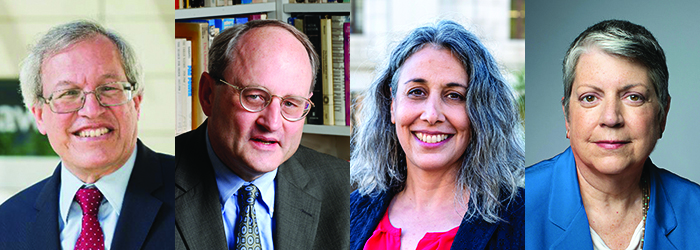
How does a country founded on a bedrock principle of freedom of speech move forward in the age of disinformation? Join UC Berkeley thought leaders Erwin Chemerinsky, Dean of Berkeley Law; Henry Brady, Dean of the Goldman School of Public Policy; and Geeta Anand, Dean of the Graduate School of Journalism for a timely discussion on the topic of the proliferation of disinformation in today’s public sphere and its intersection with a concept we hold dear: freedom of speech. Janet Napolitano, former United States Secretary of Homeland Security (2009–2013), University of California President (2013–2020), and current Professor and Faculty Director of the new Center for Security in Politics at the Goldman School of Public Policy will both moderate and participate in the discussion. Viewers will have the opportunity to submit questions for the panel upon registration.
WHAT Fact
or Fiction: Disinformation and the Freedom of Speech Livestream
WHEN Sun,
Jan 31, 2pm PST
WHERE calperformances.org/freedom-of-speech


How has GMSR adapted to remote arguments? By creating state of the art studios! Check out "GMSR Studio" - Lights, Camera, Action


And it's relevant, sort of, to this case here about appealing from sanctions orders. The set up reads like something from the appellate specialization exam. But specialists should have no trouble untangling the issues and solving the appealability puzzles presented.

The First District (20 seats) is showing vacancies in the PJ spots for Divisions 3 and 5.
The Second District (32 seats) is showing vacancies in Division 1 and 7.
The Third District (11 seats) has one vacancy.
The Fourth District (26 seats) has no vacancies (10 seats in 4/1; and 8 each in 4/2 & 4/3).
The Fifth District (10 seats) has no vacancies.
The Sixth District (7 seats) has two vacancies.
The Supreme Court (1 Chief & 6 Associate Justices) has no vacancies.
[Here's a nifty graphic "Dashboard" of "California Judicial Officers and Court Employees."]
If you ever forget how the Court of Appeal is structured in terms of borders, divisions, seats, etc., turn to Govt. Code sections 69100-69107 (Gov. Code Title 8 (Organization & Government of the Courts), chapter 4 (The Courts of Appeal).)
Also, FYI, the 9th Circuit (29 seats [28 U.S.C. sec. 44]) has no vacancies.
Appellate specialist Ryan Squire submits a cartoon for the amusement of the appellate bar:


There has been much chatter about Justices Liu and Kruger being appointed to other positions. Today's DJ, for instance has 'Attorney General Goodwin Liu,' urging Gov. Newsom to make such an appointment. Similarly, there's been talk about appointments to the 9th Cir., SCOTUS, or the SG's office. The best place to follow this conversation is At The Lectern, which today reports that Justice Kruger reportedly has declined Solicitor General job twice.
Law360 has Trump's Imprint on the Judiciary in 6 Charts, which notes:

A “respondent” is an adverse party (Cal. Rules of Court, rule 8.10(2); see also Code. Civ. Proc., § 902) and a “party” is a person appearing in an action (Cal. Rules of Court, rule 1.6(15)). ... Because these defendants never appeared below, they are not “parties.” Accordingly, we will disregard defendants’ brief and oral arguments.
Following a security audit of CM/ECF by the Department of Homeland Security, the Secretary of the Judicial Conference issued a policy directive that all federal courts start accepting highly sensitive documents (HSDs) for filing only in paper form or via a secure electronic device, and that courts store HSDs in a secure paper filing system or on a secure, standalone computer system not connected to any network. Implementation is left to each court. This administrative order establishes initial procedures to identify and ensure the security of HSDs. Modifications may be made by further administrative order or by adoption of General or Special Orders or rule changes.


The State Bar's Commission on Judicial Nominees Evaluation is evaluating Aimee Feinberg of the Cal. DOJ's SG's Office for a spot on the Third District Court of Appeal. She clerked for Justice Breyer (2004-2005) and before that D.C. Cir. Judge Tatel.
 |
| “if gerbils had bar mitzvahs …” |
Beds' latest hilarity is How Many Judges Does It Take to Change a Light Bulb? about how inept lawyers are at simple household repairs.
|
|
|

Here are some materials to celebrate today's holiday:
|
In order
to look to the future, it is often necessary to get a clear picture of the
past. In order to know where we are going, it is often necessary to see from
whence we have come. |
||||
|
||||
|
|
||||
|
• Letter from a Birmingham City
Jail (1963) |
||||
|
• March on Washington “I Have a
Dream” (1963) |
||||
|
• Martin Luther King, Jr.’s Nobel
Peace Prize Acceptance Speech (1964) |
||||
|
• “The Struggle for Civil Rights in
Mississippi” Calvin Trillin’s encounter with Martin Luther
King, Jr. on a flight to Mississippi for The New Yorker (1964) |
||||
|
• Martin Luther King, Jr.’s
appearance on NBC’s Meet The Press to discuss his historic
five-day march from Selma to Montgomery, Alabama (1965) |
||||
|
• “Where Do We Go From Here?” delivered
at the 11th Annual Southern Christian Leadership Conference in Atlanta,
Georgia, discusses boycotts, power, and love (1967) |
||||
|
• Martin Luther King, Jr.’s Final
Speech “I Have Been to the |
||||
|
• Additional Context for Martin
Luther King, Jr.’s Final Speech “I’ve Been to the
Mountaintop” (1968) |


Register at https://lacba.zoom.us/webinar/register/WN_TWgAufo4RaGg8QrR1ER81Q
Also: CLA is presenting a free program on Jan. 26:
Jan. 26, 2021 @ 5:00 PM – 6:00 PMIssues surrounding the impeachment and the 25th Amendment have dominated the headlines. Join us for an engaging discussion about how impeachment, the 14th and 25th amendments work from the perspiration two constitutional law professors. Speakers include: Loyola Law School Professors Laurie Levenson and Jessica Levinson. Moderated by Erik Silber

Justice Eugene Premo of the Sixth District Court of Appeal has announced that he is retiring effective January 15, 2021.

Kern County Superior Court has updated its local rules here. Of appellate note, Rule 1.10, covering electronic filing and service, includes subdivision (k)(14) (effective 1/1/21) noting that "Any appeal-related documents" are "not eligible for submission through electronic filing and must be filed through conventional methods."
File this under "yet another e-filing system that fails to account for appellate filings."
On other fronts, here's a nice turn of phrase (from this unpub): "The parties have engaged in protracted and torturous litigation, and the arbitrator in the second arbitration characterized it—in our view fittingly—as a “black hole of expense and rancor.”"

 |
| Welcome! How do you Do? |
This morning at 10:31 a.m. the CJA unanimously confirmed the appointment of San Diego Superior Court Judge Truc T. Do (pronounced "truck doe") as a justice on 4/1!
She fills Gilbert Nares' seat. Born in 1972, her family immigrated from Vietnam (becoming a naturalized citizen at age 11). Her first job was having a paper route. She graduated from UCLA and Stanford Law School and worked at Shepperd Mullin, then as a DA in LA (including handling murder cases) for 10 years; then she was a partner at Munger; then moved to San Diego to work at Jones Day. She understands access to justice because she grew up having to share a bathroom with six siblings. She was praised as "one of the great legal minds" in San Diego and for lives the 3 F's: Food (she is a "foodie"), Family, and Fun. Attorneys appearing before her should "be prepared and know the facts and law, because she will." After taking her oath (between 10:33-34 a.m.), she thanked the governor and promised to work hard; she thanked Marty Jenkins, the JNE Commission, the CJA, and many others, including St. Marks Methodist Church (which sponsored her family 15 years ago when they were refugees in Camp Pendleton). She knew from 7th grade that she wanted to be a lawyer. Her father's work in helping to settle war refugees inspired her to devote herself to justice.

The Recorder reports: Law Prof Who Spoke at White House Rally Abruptly Retires Amid Calls for His Firing -- John Eastman reached an agreement to immediately retire from Chapman University Dale E. Fowler School of Law.
See How Appealing for additional links.

Earn All 6 Mandatory MCLE Credits Before the Deadline (February 1, 2021)
Elimination of Bias * Legal Ethics * Competence Issues
California attorneys whose last names begin with the letters H-M are required to report their MCLE credits to the State Bar by February 1, 2021. This year, watch current, original video presentations on your own time, covering the required credits for all three mandatory subject areas: Elimination of Bias, Legal Ethics and Competence Issues.
All classes certified for California participatory MCLE credit. After registration, you will be provided course materials, evaluation forms and your Certificate of Attendance via email. Watch each recording to the end and answer the questions provided in the popup to verify your attendance.
Registration fees: $75 for all six classes on-demand. Recordings to be available no later than January 1, 2021.
 Today's DJ profiles 2/1's PJ in Advancing the Law: 2d District Justice Frances Rothschild treats each case and party with care. The article provides insights from 4/2's Justice Frank Menetrez "who worked for Rothschild for 10 years."
- She has been known to give extra time during arguments and to issue tentative opinions in advance when she feels doing so will help lawyers respond more meaningfully to the justices' view of a case. Perhaps more importantly, they say, Rothschild continues to respectfully address every issue and person appearing before her even after nearly half a century on the trial court and appellate bench.
- Rothschild traced her respect for the rule of law to her own life experiences. "I feel like it's a privilege to give back and to continue to create a history of law in this country that accepted my family as immigrants from the ashes of World War II," she said. "Every day, I am thankful I have this opportunity." Born in Poland in 1941, Rothschild was smuggled out of a Jewish work camp as an infant, entrusted to the care of a Catholic woman who pretended Rothschild was her child. Rothschild's parents managed to survive until the end of the war, but when they returned for their daughter, "there was a standoff," Rothschild said.
- Rothschild and her husband, Loren Rothschild, are rare book collectors.
- Her first job [after UCLA Law School] was as a research attorney for 2nd District Court of Appeal Justice Shirley Hufstedler, who went on to become the second woman on the federal appellate bench and eventually the first Cabinet-level secretary of education.
- No matter the issue, Rothschild is known for her even-handed approach and thorough consideration of the issues.
- "She's brilliant and practical at the same time," [said Justice Helen Bendix]. "She has a wealth of knowledge, and her instincts are good too. She isn't afraid to look at an opinion and not be wooden in how she approaches a legal issue."
Today's DJ also has Justice Hoffstadt in Pants on fire: In two cases this term, the U.S. Supreme Court will provide guidance on how appellate courts are to review the credibility of witnesses who appear before a lower tribunal.

Program One: Courts during COVID: Challenges and Successes
February 9, 2021 | Time: 4:00-5:30 p.m (PST)
Program Two: Trials over Zoom: Lessons learned and Practical Advice
February 23, 2021 | Time: 4:00-5:30 p.m (PST)
1.5 hours of MCLE per program
Cost: $25 per session or $40 for both
Space limited: Register here https://www.njchs.org/courts-during-covid/
https://www.cacd.uscourts.gov/sites/default/files/documents/Courts-During-Covid.pdf

After presentations, panelists will engage in a live question and answer session with
participants.
For more information or to register >
Or call 1-800-926-7926
Ask for Federal Appeals and Motions Practice on 2/16/2021
Mention code: NL1AU1-C7OVAZ
Beds starts off this unpub'd decision here, like this:
Writers in training are often told to “show, don’t tell” – allow the reader to experience the story through action rather than being spoon-fed it in narrative. “Show, don’t tell” is also good advice for lawyers. Indeed, “show, don’t tell” is a defining skill in trial advocacy and especially important in plaintiff’s civil litigation. A plaintiff cannot merely say he has a claim; he must actually prove it. He must “show” his evidence, rather than “tell” through his allegations.
Today's DJ has an article by retired Justice Nicholson of the 3d District titled Visionary Becomes State's New Judicial Appointments Secretary: Few people outside the legal profession realize that Luis Cespedes, the governor’s newly named Judicial Appointments Secretary, has been a leader in increasing diversity and inclusivity among lawyers and judges for more than 30 years.
Cases based on facts... must have facts. The facts lead to the law, its interpretation, and its application to the facts. Granted, how judges interpret those facts can lead to differences of opinion. That is why judges have a limited circle of friends in constant flux. Judges are grateful for their appointments, but our oath of office compels loyalty to an ideal that dwarfs loyalty.
...
My court has conducted oral argument via Bluejeans several times this year, and I confess I have worn bluejeans during a few of those oral argument sessions. And a caution to attorneys and judges conducting such arguments. What you see of yourself on your screen, others see the same on their screens. This includes what goes on in the background. This is a respectful publication so I will not relate ... never mind. Forget I even brought it up.
...
And I end with a goodbye to two good friends and colleagues who recently passed away, two exceptional people whose contribution to the judiciary endures. Court of Appeal Justice Rick Sims of the 3rd District and I were appointed to the Court of Appeal in...oh dear...1982. His opinions reflected clarity, wisdom, and scholarship. He was the ideal justice with a subtle sense of humor and firm grasp of the rule of law and common sense. I commend you to read "What Appellate Judges Do," 7 J. App. Prac. & Process 193 (2005). It is one of the best explications of what the courts do. It is a must read. I also suggest you view his interview on the oral history of appellate justices on YouTube.
And we will all miss Joan Dempsey Klein of the 2nd District Court of Appeal. I knew Justice Klein for a few years...since...1965. Yikes! .... She was an inspiration to women in the law and responsible for the careers of many of our distinguished women lawyers and jurists. So to add to your viewing pleasure, I urge you to watch the oral history of Justice Klein on YouTube

- The pass rate on California’s October 2020 general bar exam—the first ever administered online—climbed to 60.7%, reflecting the state’s new lower passing, or cut, score of 1390. The success rate is the highest since July 2008, when applicants still needed a score of 1440 to pass.
- The results, released by the state bar on Friday night, show that 84% of first-time test-takers from American Bar Association-approved law schools in California, the cohort that typically performs the best, passed. Half of repeat test-takers from that group posted passing scores.
- Just over 9,300 applicants completed the exam, the largest number since 2013.
- “We heartily congratulate the 5,292 applicants who passed the general bar exam and the 323 candidates who passed the Attorneys’ Exam in this tremendously challenging year,” the bar’s interim executive director, Donna Hershkowitz, said in a prepared message. “We are pleased that the first-ever remote bar exam will result in such a large influx of new attorneys at a time when more people than ever need legal help.”
1/11/21 update: See Who Passed California's October 2020 Bar Exam:

 Posts
All Comments
Posts
All Comments